
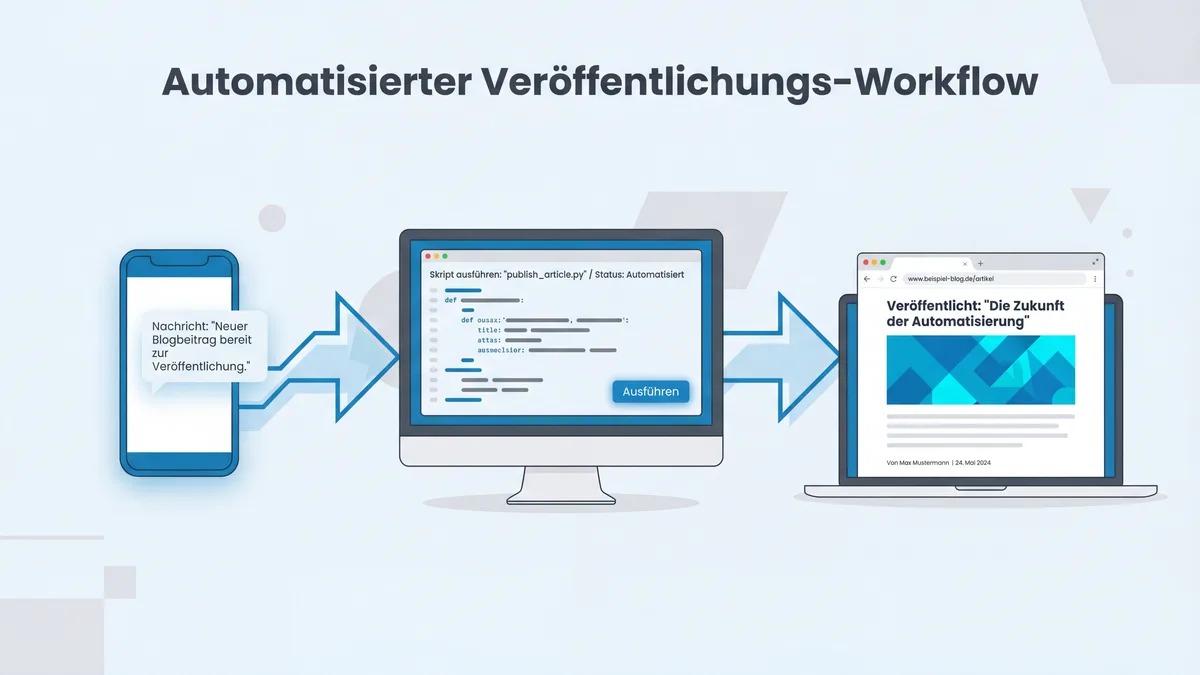
Claude Code Dispatch is a routing mechanism inside Claude Cowork that automatically forwards a message from your phone to the right AI agent — coding tasks go to Claude Code sessions, knowledge tasks to Cowork. It’s the missing link between a spontaneous idea and a fully automated multi-step workflow.
Content teams today juggle brief, research, SEO check, drafting, image production, and CMS upload — every handoff costs time, creates inconsistencies, and depends on individuals. But the real bottleneck isn’t execution speed, it’s reproducibility: the same quality in every session, with any team member, without someone supervising every step. Claude Code Dispatch with predefined AI skills solves exactly this problem. The article you’re reading right now was produced through this very workflow.
Das Wichtigste in Kürze
- Dispatch as a routing layer: Messages from your phone are routed automatically to Claude Code sessions — coding and content tasks then run fully autonomously with no human intermediate steps.
- Skills as a production pipeline: Reusable SKILL.md files encode complex workflows — from keyword research to fact check to brand-conformant images and automatic deploy.
- Reproducible quality: According to GitHub research, developers complete tasks 55% faster with AI assistance. The real lever isn't the model — it's the engineering architecture behind it.
This article shows the precise architecture of the dispatch-based content workflow, walks through every step using this real-time session as the example, and assesses honestly who this approach actually makes sense for.
What is Claude Code Dispatch?
Claude Cowork launched in January 2026 as an extension of Claude Code — designed for knowledge work like documents, research, and structured drafts beyond pure coding tasks. Dispatch, released in March 2026 as a research preview for Pro and Max plan users, bridges those worlds.
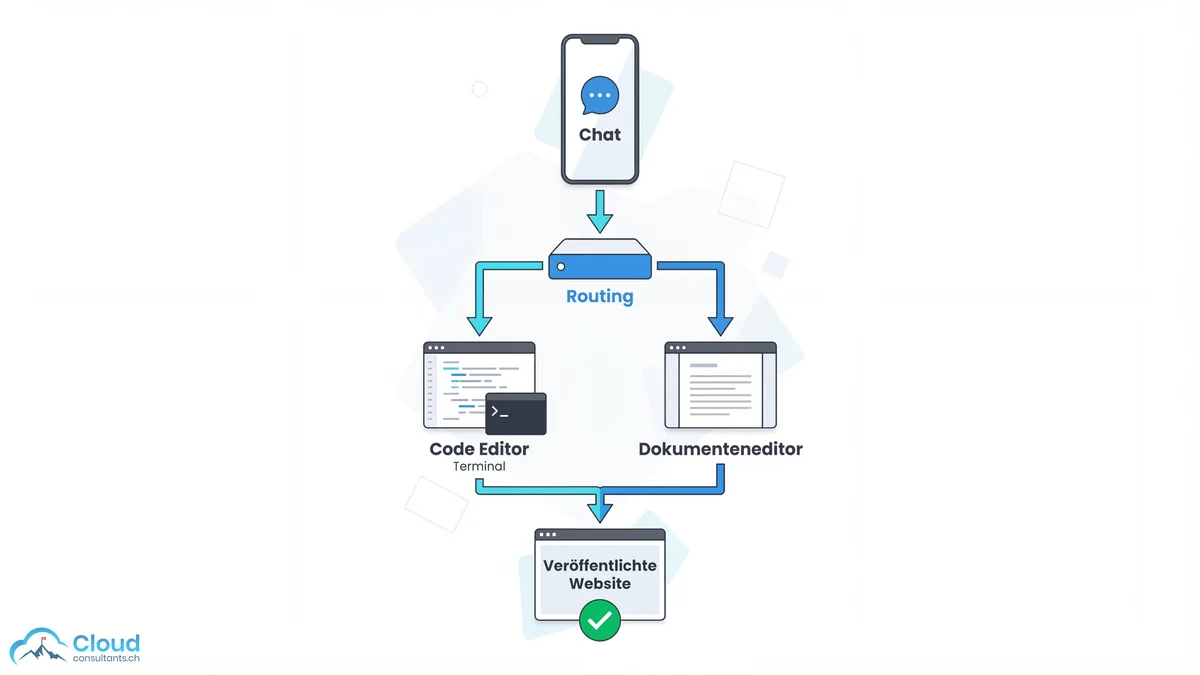
Technically, Dispatch creates a persistent thread between the Claude mobile app and Claude Desktop. The mechanism is radically simple: you write a message on your phone — and Dispatch decides automatically which agent the task should go to. Tasks that need file access, code, or system operations land in a Claude Code session. Pure knowledge tasks go to Cowork.
The crucial part: the desktop machine executes the task autonomously while you’ve already put the message away. You don’t supervise intermediate steps. The result waits in the thread when you return.
That apparent simplicity hides the real complexity on the right side — the engineering side. Not in the messaging box, but in the CLAUDE.md files, the skill pipelines, and the CI/CD architecture behind it.
The technical architecture — from phone to live URL
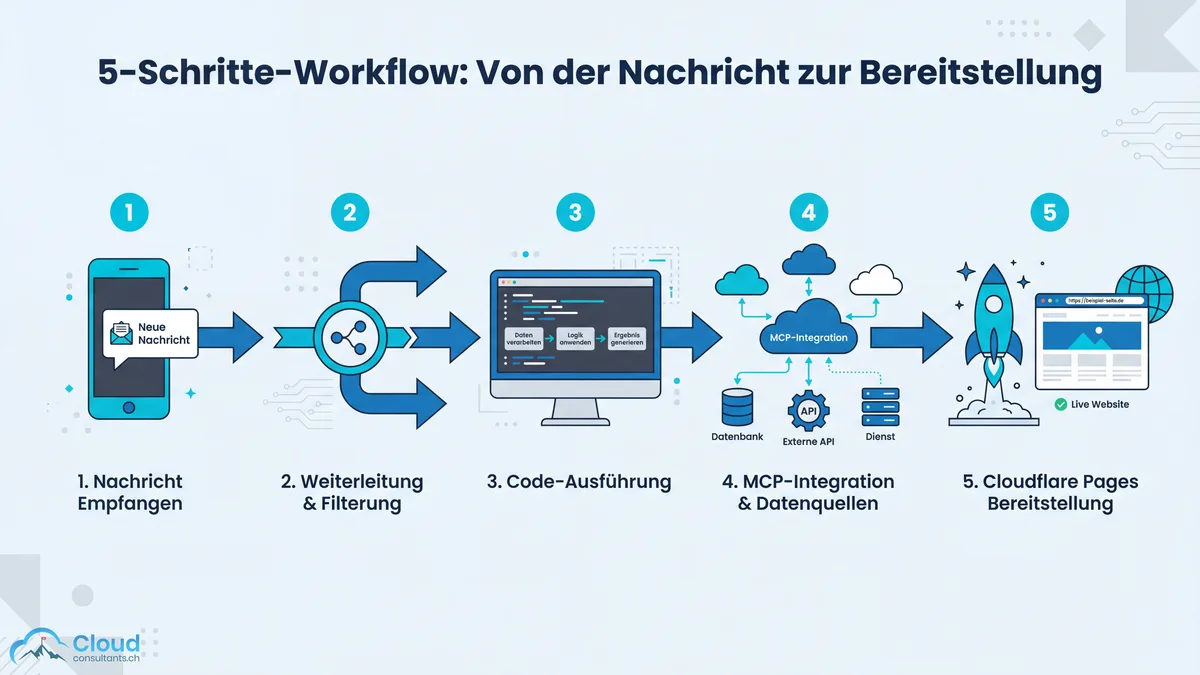
For our content-publishing workflow, the full chain looks like this:
Layer 1 — Dispatch routing: a message on your phone lands via Dispatch in a Claude Code session that opens in a Git worktree of the website repository. Claude works on an isolated branch copy — changes don’t touch main until an explicit push.
Layer 2 — Context loading: Claude Code automatically loads CLAUDE.md (project rules, conventions, paths) and any relevant skill files from .claude/skills/. In this case, write-cluster-article/SKILL.md — a 13-step pipeline executed identically in every session.
Layer 3 — Skill execution: the agent runs the pipeline autonomously. It reads brand files (tone-of-voice.md, icp.json, brand-system.md), creates a cluster definition if needed, kicks off a fact-research subagent, and writes the article using only verified sources.
Layer 4 — MCP integrations: external tools are wired in directly via the Model Context Protocol. DataForSEO provides keyword data. Google Search Console provides current ranking information. The AI works with live data — no manual copy-paste, no screenshots.
Layer 5 — CI/CD trigger: after a successful pnpm build (zero errors), a Git commit is created and pushed to main. Cloudflare Pages detects the push and deploys automatically. The live URL is reachable within seconds.
According to McKinsey, developers complete coding tasks up to twice as fast with generative AI. For structured, skill-driven workflows — where the AI isn’t just writing but also researching, checking, illustrating, and deploying — that’s a conservative estimate.
The workflow in practice — this session as a real-time example
This isn’t a constructed example. This article was produced through exactly the workflow described. The session started with a dispatch message that defined the article brief. What happened next:
1. Cluster definition created: for the new ki-entwicklung cluster, a complete cluster definition was set up — pillar page, five spoke articles, a link map, and content-strategy notes for the DACH market.
2. Branding files read: tone-of-voice.md, icp.json, brand-system.md — so that every phrasing fits the brand and targets the right ICPs. These files are re-read in every session — no stale context from previous runs.
3. Fact-research subagent launched: a separate subagent ran 26 web searches and API calls to gather verified statistics on AI productivity, Claude Code features, and DACH market data. The result: a fact sheet with 20+ verified sources. The subagent architecture protects the main context window — all search results stay inside the subagent’s context and don’t burn through the main agent’s 200k tokens.
4. Article written: using only facts from the fact sheet. Every statistic is mapped to a named source and linked in the text.
5. Fact-check audit: every number in the article is checked against the fact sheet. Statistics without a verified origin are replaced with qualitative phrasing. No fabricated percentages.
6. Hero image and 4 section images generated: AI-generated illustrations with the brand-style prompt automatically injected. Section images get a logo overlay (bottom-left, 85% opacity), hero images don’t.
7. Build and deploy: pnpm build with no errors. Git commit. Push to main. Cloudflare Pages deploys automatically — the URL goes live.
51% of professional developers use AI tools daily, according to the Stack Overflow Developer Survey 2025 (49,000+ respondents). What two years ago was a productivity aid is now production infrastructure.
Skills as a reproducible production pipeline
The real lever in this system isn’t the AI models — Claude Opus 4.6 is available to anyone. The lever is the skills.
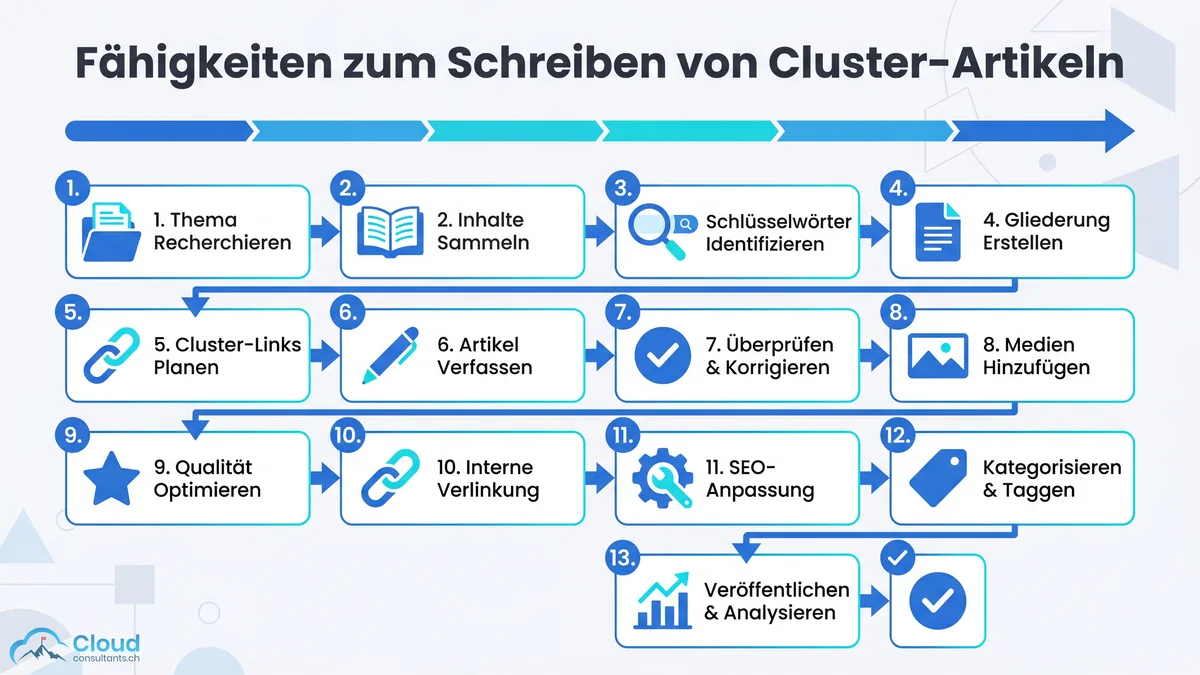
A SKILL.md file is a structured instruction file that Claude runs like a workflow script. Our write-cluster-article skill has 13 steps — from cluster definition to final report. Every session runs the exact same pipeline. That means:
- Consistent brand voice in every article, because the same branding files are read in every run
- Zero fabricated statistics, because the fact-check step is structurally embedded in the workflow and can’t be skipped
- Automatic interlinking architecture, because the skill knows the cluster definition and which sibling articles should be linked
- Reproducible image quality, because the brand-style prompt is automatically injected into every image-generator call
GitHub research measured in a controlled study with 95 developers: tasks were completed 55% faster with AI assistance (1 hour 11 minutes vs. 2 hours 41 minutes, p=0.0017). 73% of developers reported staying in flow more easily. Those numbers are for coding tasks — structured content workflows with a predefined pipeline see comparable effects.
That’s the difference between “chatting with AI” and “engineering with AI”. The first approach doesn’t scale. The second produces new articles weekly, each at the same quality bar, without anyone supervising each step.
Content velocity in the DACH context
36% of German companies are using AI — almost double the prior year, according to Bitkom Research 2025 (604 companies surveyed, 20+ employees). 81% see AI as the most important future technology. The shift isn’t hypothetical anymore — it’s measurable.
For content teams, the shift turns into a concrete question. Not “should AI write the article?”, but “which engineering architecture ensures every AI-generated article is on-brand, fact-checked, and SEO-optimised?” A dispatch-based workflow with structured skills answers that question.
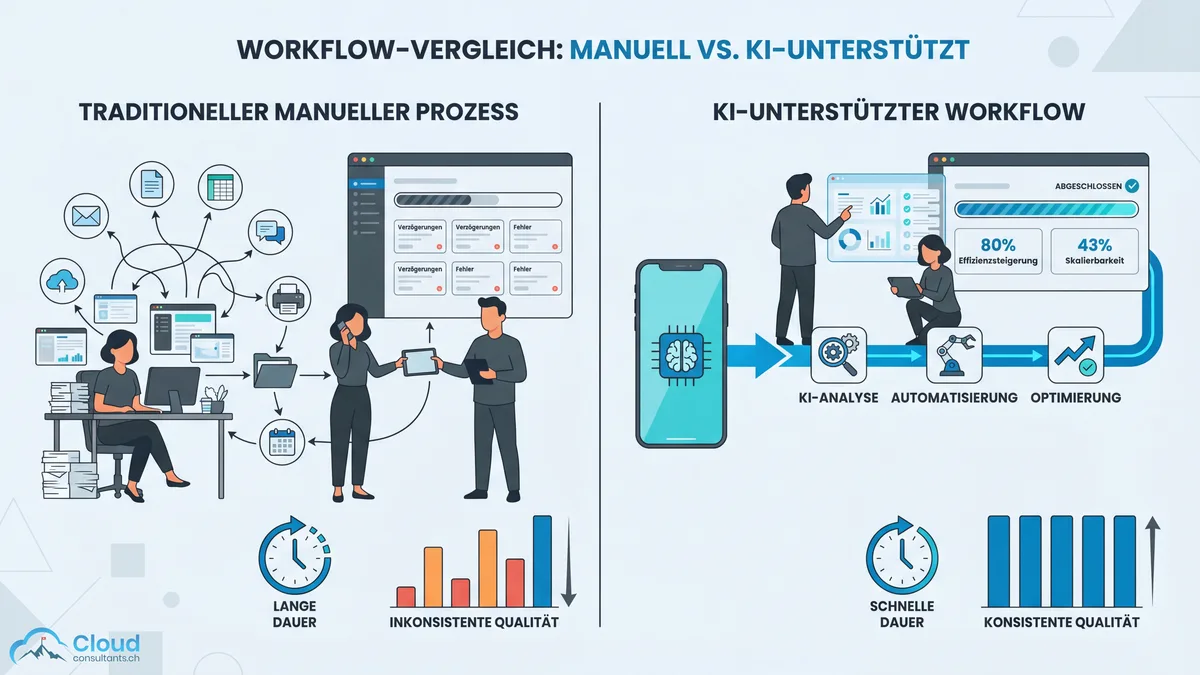
The difference from a classic editorial process isn’t only speed. It’s consistency at scale. A human editorial team producing ten articles a week sees quality variance — different authors, different research depth, different brand-rule adherence. A skill-driven AI workflow runs the same process in every session. Not because AI is “better” than humans, but because the process is defined as code and therefore repeatable.
Requirements and honest limits
This workflow isn’t immediately ready for every team. Here are the requirements and — more importantly — the honest limits:
Technical infrastructure (required):
- Claude Pro or Max plan (Dispatch is currently in research preview)
- Claude Desktop on a Mac or Windows machine that must stay active during execution
- Git repository with Cloudflare Pages or a comparable auto-deploy service
- A prepared CLAUDE.md project file with project structure, conventions, and paths
- SKILL.md files for every reproducible workflow
Content infrastructure (required):
- Defined brand rules in file form (tone of voice, ICP, brand system)
- Cluster definitions for all planned topics
- Fact-check processes that ensure statistics are verified before use
What this workflow does not replace: Strategic decisions on topics and priorities. Quality control on technically complex statements. The Stack Overflow Developer Survey 2025 shows: only 29% of developers trust AI output without review — a healthy stance that applies equally to content workflows. The workflow delivers a verified, on-brand draft. The final sign-off stays with the human.
What this workflow is particularly good at: Cluster-based content production where the same format and the same quality rules must be applied consistently across many articles. SEO-optimised articles with correct interlinking, verified statistics, and structured FAQ schema — reproducibly, not just once.
Building the infrastructure takes time — typically several days for a complete content system. What emerges afterward is a production machine that pays back the investment in its first weeks.
Frequently asked questions
What is Claude Code Dispatch and how does it work?
Claude Code Dispatch is a feature inside Claude Cowork (in research preview since March 2026 for Pro and Max plan users) that lets you send tasks from your phone to a persistent AI agent running on your desktop. Dispatch creates a durable thread between the Claude mobile app and Claude Desktop. Tasks are routed automatically — coding tasks go to Claude Code sessions, knowledge tasks to Cowork. The agent works autonomously while you do something else.
How long does it take to go from idea to published article with Claude Code Dispatch?
With a structured workflow — prepared skill files, brand rules, and an existing Git repository — the full process from dispatch message to live article on Cloudflare Pages typically takes 30 to 90 minutes, depending on article complexity. Human time is limited to the task definition (a few minutes) and optional quality control at the end.
What do you need to use Claude Code Dispatch for content publishing?
Technical requirements: a Claude Pro or Max plan, Claude Desktop on a Mac or Windows machine, a Git repository with a CI/CD pipeline (e.g. Cloudflare Pages), prepared SKILL.md files, and a CLAUDE.md project file. On the content side, you need defined brand rules, cluster definitions, and a reproducible article structure.
Is Claude Code Dispatch suitable for less technical teams?
The initial setup is significant — Git repository, CI/CD pipeline, CLAUDE.md and skill files require technical understanding. Once the system is set up, however, it can be triggered with simple text messages. The agent handles all technical steps autonomously. For teams without a Git workflow, we recommend building the technical infrastructure first.
What's the difference between Claude Code Dispatch and a normal AI chatbot?
A normal AI chatbot returns text answers in a chat window — the human still has to push every step forward manually. Claude Code Dispatch kicks off a fully autonomous agent that runs multi-step tasks on its own: reading files, writing code, calling external APIs, generating images, creating Git commits, running the build. The human defines the goal; the AI executes all intermediate steps.